


Customer Credentials
A leading pharmaceutical equipment manufacturer specializing in sterile processing and containment systems was developing an automated Rapid Transfer Port (RTP) for use in isolator applications. These systems play a critical role in pharmaceutical manufacturing by enabling materials to be transferred into controlled environments without compromising sterility.
For equipment operating in such highly regulated environments, airflow performance is not simply a design consideration—it is a fundamental requirement. Consistent and predictable airflow helps maintain contamination control, protects products during processing, and supports compliance with stringent pharmaceutical standards. Even minor airflow disturbances can create localized turbulence, affect the overall performance of the isolator and increase the risk of contamination.
During the development of a new automated RTP system, the customer identified concerns regarding airflow behavior around the motor-driven transfer mechanism. Before proceeding with physical testing and validation activities, the company sought support from MN Engineering Solutions to better understand the airflow characteristics and identify opportunities for design improvement.
The Challenge
The automated RTP utilized a motorized mechanism to facilitate material transfer operations within the isolator. While the system met its functional requirements, the engineering team suspected that the location of the motor assembly could be affecting airflow within the transfer area.
The motor was positioned close to the basket axis and partially within a critical airflow path. Preliminary observations suggested that this arrangement could be creating localized turbulence and disrupting the intended airflow pattern inside the isolator.
For pharmaceutical equipment manufacturers, such disturbances can have significant implications. Uneven airflow distribution can create regions of low air velocity or recirculation, potentially allowing contaminants to accumulate. This not only impacts product protection but can also complicate validation activities and regulatory compliance efforts.
The customer needed clear answers to several important questions: Was the motor placement significantly affecting airflow performance? Were there areas of turbulence or recirculation that could increase contamination risk? Could the design be improved without compromising functionality? What modifications would provide the greatest benefit while minimizing redesign effort?
Physical testing alone would have required multiple design iterations, additional prototypes, and extended development time. The customer therefore chose to evaluate the design through Computational Fluid Dynamics (CFD) analysis before implementing design changes.
MN Engineering Solutions Approach
MN Engineering Solutions conducted a detailed CFD study using ANSYS Fluent to evaluate airflow behavior within the RTP assembly and surrounding isolator environment.
The objective was not merely to generate simulation results but to understand how the mechanical design interacted with the airflow system and identify practical engineering improvements.
The analysis focused on several key areas: airflow distribution around the RTP assembly, velocity variations near the motor and transfer basket, flow separation and turbulence generation, air recirculation zones that could impact contamination control, and overall airflow uniformity within the transfer area.
A digital model of the assembly was developed, and operating conditions representative of actual isolator use were applied. The simulations enabled engineers to visualize airflow paths throughout the system and assess how individual components influenced flow behavior. Rather than relying on assumptions, the customer was able to see exactly how the motor installation affected airflow performance under realistic operating conditions.
Key Findings
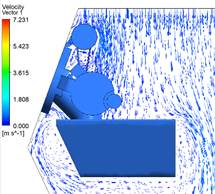
The CFD results confirmed that the motor location was creating a significant obstruction within the airflow path.
As air moved through the transfer region, the motor housing disturbed the flow, resulting in localized turbulence around the basket area. The analysis also revealed recirculation zones and eddy formation near the motor assembly. These regions disrupted airflow uniformity and reduced the effectiveness of the controlled airflow environment.
The study showed that while the RTP was mechanically functional, the motor arrangement introduced unnecessary airflow disturbances that could potentially impact contamination control performance. The findings provided the customer with valuable insight into the root cause of the airflow issues and established a clear direction for design improvement.
The study showed that while the RTP was mechanically functional, the motor arrangement introduced unnecessary airflow disturbances that could potentially impact contamination control performance.
Engineering Recommendations
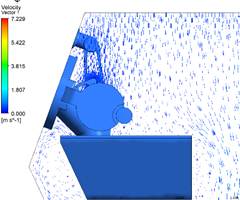
Based on the simulation results, MN Engineering Solutions recommended a series of targeted design modifications. The primary recommendation was to relocate the motor away from the basket axis and the critical airflow path. By moving the motor outside the primary flow region, airflow could pass through the transfer area with significantly less obstruction.
A dedicated mounting arrangement was also recommended to separate the drive system from the airflow-sensitive region. This provided greater flexibility in positioning the motor while maintaining the required mechanical functionality.
Additionally, the team suggested evaluating a more compact motor configuration where feasible. Reducing the physical size of the motor would further minimize airflow disruption and improve overall flow uniformity. These recommendations were developed with both airflow performance and practical implementation considerations in mind, allowing the customer to improve the design without major changes to the overall system architecture.
Results and Business Impact
Following implementation of the recommended design changes, the customer achieved a noticeable improvement in airflow performance within the RTP assembly. The revised configuration reduced turbulence levels and eliminated several recirculation zones identified during the initial analysis. Airflow distribution became more uniform throughout the basket area, helping maintain the controlled environment required for sterile material transfer operations.
Beyond the technical improvements, the project delivered important business benefits. By identifying potential issues early in the design cycle, the customer avoided costly design revisions during later stages of development. The CFD study also reduced the need for multiple physical prototypes, helping shorten development timelines and lower engineering costs.
Most importantly, the customer gained greater confidence in the RTP design before entering formal validation activities. The improved airflow performance supported contamination control objectives and strengthened the overall robustness of the isolator system.
Old Design
New Design
Conclusion
MN Engineering Solutions helped a leading pharmaceutical equipment manufacturer address a critical airflow challenge within an automated Rapid Transfer Port system through the application of CFD analysis.
By identifying the impact of motor placement on airflow behavior and providing practical design recommendations, MNES enabled the customer to improve airflow uniformity, reduce contamination risk, and optimize the RTP design before physical validation.
The project demonstrates how simulation-driven engineering can help pharmaceutical equipment manufacturers make informed design decisions, reduce development risk, and achieve higher levels of performance in contamination-sensitive applications.