


Customer Credentials
Our client is an automotive electronics and embedded systems solutions provider focused on developing and validating LIN-based communication systems for intelligent automotive applications. The project involved LIN network configuration enhancement, node integration, and LED communication protocol analysis for automotive electronic control systems.
Challenge
The client required modifications and validation within an existing LIN communication setup using the BABY-LIN-RM-III platform. The objective was to study the existing LIN architecture, update the session description configuration, and integrate a new Lamp node with associated frames and signals.
The project also required analysis of LED communication protocols including J2602_1_1 and DCU protocols, along with evaluation of alternative approaches for current measurement across LED systems.
The implementation demanded a detailed understanding of LIN communication architecture, scheduling mechanisms, signal mapping, and automotive protocol behaviour to ensure stable and reliable communication performance. Any minor misconfiguration could impact system functionality, make precision and understand critical.
Implications of the Problem
- Existing LIN network configuration required modification for additional node
integration
Incorrect configuration updates could disrupt communication between LIN master and slave nodes, resulting in communication failures, loss of synchronization, and incorrect data transmission. - Incorrect frame or signal mapping could impact communication reliability. Improper frame and signal mapping could result in Incorrect data transmission, Signal misinterpretation and Functional failures in automotive systems
- Improper scheduling configuration could lead to synchronization and data transmission issues
- Limited understanding of LED communication protocols could affect system
validation accuracy. Without proper study of J2602_1_1 and DCU
protocols:
- Validation accuracy decreases
- Protocol-level debugging becomes difficult
- Difficulty in measuring current across LED systems could affect system diagnostics, performance evaluation, and fault detection.
Solution Implemented by MN Engineering Solutions
MN Engineering Solutions adopted a structured engineering methodology to enhance the existing LIN communication system while ensuring minimal disruption to the operational network. The project began with a comprehensive review of the existing LIN architecture using the BABY-LIN-RM-III communication platform and LIN Works engineering software.
Engineers first analysed the original Session Description File (test1.sdf) to understand the existing network structure, communication hierarchy, node configuration, signal assignments, scheduling tables, and frame definitions. This analysis helped identify the necessary modifications required to integrate the new Lamp node.
A new Session Description File (test1_with_lamp.sdf) was then developed by incorporating the additional Lamp node along with its corresponding communication frames, signal definitions, and scheduling information. Careful attention was given to maintaining compatibility with existing nodes while ensuring reliable communication across the entire LIN network. The engineering team mapped all signals accurately to their respective communication frames and verified that each message was transmitted according to the required communication schedule. This ensured consistent data exchange between the master controller and slave devices.
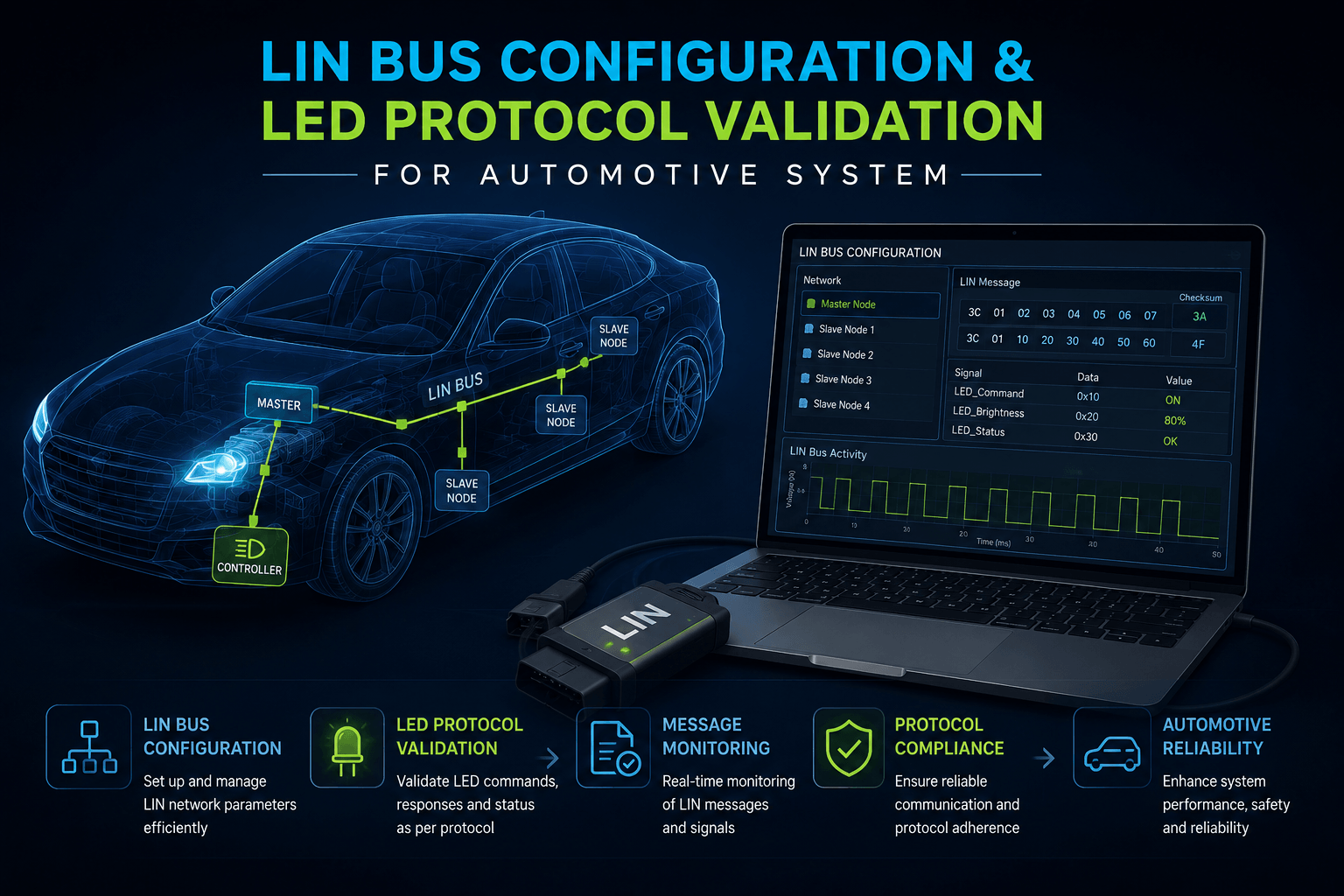
System Features & Implementation
- Studied and analysed the BABY-LIN-RM-III communication module
- Reviewed existing nodes, frames, and signals within the LIN network
- Created and integrated a new Lamp node into the LIN architecture
- Added new frames and signals for lamp communication
- Mapped frames and signals within the updated configuration
- Developed and updated scheduling tables for new node communication
- Conducted LIN protocol study for J2602_1_1 and DCU protocols
- Evaluated alternate methods for current measurement across LED systems
- Performed configuration validation using LIN Works tools
Engineering & Development
MNES implemented a structured approach for LIN network enhancement and protocol validation by:
- Reviewing existing session description architecture
- Updating SDF configurations for new node integration
- Validating frame communication and scheduling logic
- Analysing protocol behaviour for stable LIN communication
- Studying LED current measurement techniques for improved diagnostic capability
This approach helped ensure reliable communication, accurate signal mapping, and improved understanding of protocol-level behaviour within the automotive LIN environment.
Protocol Study & Validation
MN Engineering Solutions conducted a detailed study and validation of the J2602_1_1 and DCU communication protocols used in the automotive LED system. The team analysed message structures, signal mapping, communication timing, checksum validation, and protocol behaviour to ensure reliable data exchange and compliance with LIN communication standards. This validation improved communication accuracy, enhanced debugging capability, and ensured stable operation of the LED control system.
LED Current Measurement Techniques
To improve LED diagnostics, MNES evaluated various current measurement techniques, including shunt resistor, sensor-based, and software estimation methods. Each approach was assessed for accuracy, reliability, and suitability for automotive applications, helping identify effective solutions for performance monitoring and fault detection to support predictive maintenance.
Technology Stack
| Category | Technology / Tool Used |
|---|---|
| Communication Protocol | LIN (Local Interconnect Network) |
| Hardware Interface | BABY-LIN-RM-III |
| Configuration Software | LIN Works |
| Configuration File | Session Description File (SDF) |
| Communication Standards | J2602_1_1, DCU Protocol |
| Development Activities | Node Integration, Frame & Signal Mapping |
| Validation | Protocol Analysis, Communication Testing |
| Testing Tools | LIN Works Debugging & Monitoring Tools |
| Engineering Domain | Automotive Embedded Systems |
Testing & Validation
The enhanced LIN network underwent comprehensive testing to verify successful integration of the new Lamp node. Frame transmission, signal mapping, scheduling logic, and communication timing were validated using LIN Works tools, ensuring reliable network performance and compliance with project requirements.
The validated configuration ensured reliable communication under different operating scenarios before deployment.
The Outcome or Results
By implementing the LIN configuration enhancement and protocol validation study, MNES enabled the client to achieve a stable and scalable LIN communication setup. Key results included:
- Successful LIN Node Integration: New Lamp node, frames, and signals were successfully integrated into the existing LIN network architecture.
- Improved Communication Configuration: Updated scheduling and signal mapping ensured stable LIN bus communication performance.
- Enhanced Protocol Understanding: Detailed study of J2602_1_1 and DCU protocols improved protocol-level analysis and validation capability.
- Efficient Configuration Validation: LIN Works-based testing simplified debugging and verification of network communication.
- Improved LED Measurement Analysis: Alternate current measurement approaches for LED systems were evaluated to support future diagnostics and validation activities.
Conclusion
Through its expertise in embedded systems, automotive communication protocols, and validation engineering, MN Engineering Solutions successfully enhanced the client's LIN communication network by integrating a new Lamp node and validating LED communication protocols. The project improved communication reliability, protocol understanding, and diagnostic capability while providing a scalable architecture for future system expansion. The successful implementation demonstrates MNES's capability to deliver reliable, standards-compliant embedded engineering solutions for modern automotive applications.