

Customer Credentials
The customer is a leading U.S.-based manufacturer serving the tool and die industry, specializing in the design and production of precision tooling, dies, and custom manufacturing equipment used across automotive, industrial, appliance, and heavy engineering sectors. Their products are expected to deliver high levels of accuracy, repeatability, and durability while operating under demanding production environments.
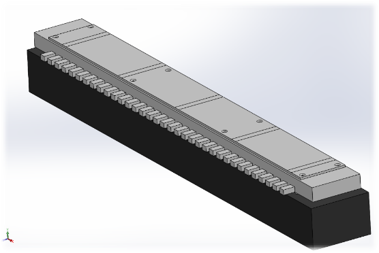
The customer was developing a critical machine assembly used within a tool and die manufacturing environment and required engineering support to validate the design before fabrication. The objective was to improve confidence in the design, identify potential structural weaknesses, and optimize key components to ensure reliable performance throughout the equipment's operational life.
Situation / Challenge
The machine assembly under development was required to withstand a combination of static and dynamic loads generated during production operations. Given the precision requirements of the tool and die industry, even small levels of deformation or unexpected stress concentrations could adversely affect machine performance, dimensional accuracy, and long-term reliability.
Historically, the customer relied heavily on physical prototype testing and design iterations to validate new equipment. While this approach ultimately resulted in a functional design, it often led to lengthy development cycles, increased engineering effort, and significant manufacturing costs. Design issues were frequently discovered only after fabrication, resulting in rework, modifications, and delays to project schedules.
The engineering team needed a better understanding of how the machine assembly would behave under real operating conditions. Critical questions included:
- Whether the assembly could safely withstand the anticipated loading conditions.
- Which areas of the structure were most susceptible to high stresses.
- Whether critical components were adequately designed or unnecessarily over-engineered.
- How different loading scenarios would affect overall assembly performance.
- Whether opportunities existed to improve reliability while reducing material and manufacturing costs.
Without simulation-based validation, these questions could only be answered through repeated physical testing, consuming valuable engineering and production resources.
The customer therefore sought a predictive engineering approach that would enable design verification early in the development process and reduce dependence on trial-and-error design practices.
The customer therefore sought a predictive engineering approach that would enable design verification early in the development process and reduce dependence on trial-and-error design practices.
Implications
The lack of detailed structural validation presented several business and engineering risks.
Repeated design iterations increased project costs and delayed product launches. Structural weaknesses discovered during testing or production could lead to premature failures, machine downtime, warranty claims, and costly corrective actions. In precision manufacturing environments, reliability issues can also affect productivity and product quality, creating additional challenges for end users.
Furthermore, without visibility into stress distribution, deformation patterns, and safety margins, the engineering team had limited ability to optimize the design. Components could be overdesigned, increasing material costs and machine weight, or underdesigned, creating risks to performance and durability.
The customer required a reliable engineering methodology that could provide detailed insight into assembly behavior while minimizing development risks and reducing overall project costs.
Solution Implemented by MNES
MN Engineering Solutions (MNES) partnered with the customer to implement a simulation-driven design validation approach using Finite Element Analysis (FEA). The objective was to evaluate the machine assembly under realistic operating conditions and provide actionable recommendations before manufacturing commenced.
The project began with a detailed review of the assembly design, machine functionality, operational requirements, and anticipated loading conditions. MNES worked closely with the customer’s engineering team to understand the performance expectations and identify critical areas requiring evaluation.
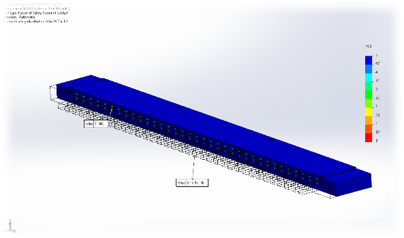
Using SolidWorks Simulation, MNES developed a detailed finite element model of the complete machine assembly. Appropriate material properties, constraints, and loading conditions were incorporated to accurately represent actual service conditions.
A series of structural analyses was conducted to evaluate the assembly under multiple operating scenarios. The simulations enabled detailed assessment of:
- Stress distribution across structural members and load-bearing components.
- Strain behavior under operational loading.
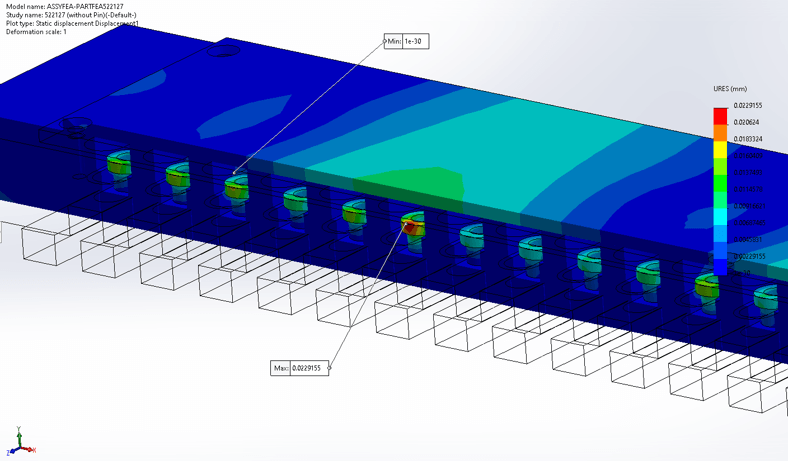
- Deflection and displacement characteristics.
- Load transfer paths throughout the assembly.
- Factor of Safety (FOS) against potential failure.
Special attention was given to understanding the interaction between key components and identifying locations where stress concentrations could develop. The engineering team analyzed how loads were distributed through the structure and evaluated the impact of various operating conditions on assembly performance.
One critical component—a load-carrying pin within the assembly—was subjected to detailed evaluation. Multiple loading cases were simulated to determine its performance under varying operating conditions. Through iterative analysis and optimization, MNES identified opportunities to improve the design while maintaining the required safety margins.
Beyond simply validating the design, MNES used the simulation results to support design optimization efforts. Areas where material could be reduced without compromising performance were identified, while regions requiring additional reinforcement were highlighted for improvement.
Comprehensive engineering reports were prepared, providing detailed insights into assembly behavior, stress patterns, displacement characteristics, and recommended design modifications. These findings enabled the customer to make informed engineering decisions with confidence and significantly reduced uncertainty during the development process.
Outcome
The use of Finite Element Analysis transformed the customer's approach to machine design validation and provided a clear understanding of assembly performance before fabrication.
The project delivered several measurable benefits:
- Improved understanding of machine assembly behavior under various operating loads.
- Early identification of potential structural weaknesses and stress concentration zones.
- Optimization of critical pin design through evaluation of multiple loading conditions.
- Reduced risk of unexpected failures during operation.
- Enhanced structural integrity and reliability of the final assembly.
- Improved confidence in manufacturing readiness and production release.
- Reduced reliance on costly physical prototypes and repeated design iterations.
- Faster engineering decision-making supported by simulation-based validation.
- Better balance between performance, reliability, and manufacturing cost.
Most importantly, the customer gained a predictive engineering capability that allowed potential issues to be addressed during the design phase rather than after fabrication. This significantly reduced development risk and improved overall project efficiency.
By integrating advanced FEA techniques into the product development process, MN Engineering Solutions helped the customer achieve a more robust, reliable, and optimized machine assembly while reducing development costs and shortening the design validation cycle. The project demonstrated MNES's expertise in structural analysis, machine design validation, and simulation-driven engineering solutions for the tool and die industry.