


Customer Credentials
Our client is a manufacturing company focused on improving internal material handling and production efficiency through industrial automation solutions. The organization aimed to optimize the deployment of Mobile Industrial Robots (MiR) across multiple manufacturing processes to improve throughput, reduce idle time, and enhance operational efficiency.
Challenge
The client required an optimized material handling strategy for transporting totes between multiple Auto Bagging Machines (ABM) within the manufacturing facility. The objective was to evaluate the performance of MiR robots under different operating conditions and identify the most efficient deployment strategy.
The project required detailed simulation and analysis using FlexSim software to study robot utilization, task allocation, charging behaviour, throughput, and operational bottlenecks before actual implementation.
Initially, both single-MiR and dual-MiR deployment scenarios were evaluated to determine the best operational configuration for the production environment.
Project Scope
The objective of this project was to optimize the deployment of Mobile Industrial Robots (MiRs) for automated material handling within a manufacturing environment using FlexSim simulation. Rather than directly implementing automation on the shop floor, the client required a simulation-driven approach to evaluate different MiR deployment strategies, identify operational bottlenecks, and determine the most efficient configuration before physical deployment.
MN Engineering Solutions (MNES) developed a digital simulation model representing the complete material flow between four Auto Bagging Machines (ABMs). The project scope included modelling MiR movement, material transportation, loading and unloading operations, charging behaviour, task scheduling, and resource allocation under realistic production conditions. Multiple deployment scenarios, including single and dual MiR configurations, were analysed to evaluate throughput, utilization, travel distance, idle time, blocked time, and overall production efficiency. The simulation results enabled the client to make data-driven decisions while minimizing implementation risks, reducing commissioning time, and optimizing manufacturing performance.
Implications of the Problem
Leaving the intralogistics network unoptimized introduced compounding operational inefficiencies:
- Production Bottlenecks: Inefficient material handling reduced production efficiency and increased operational delays.
- Asset Underutilization: High idle and blocked times resulted in poor MiR utilization.
- Task Allocation Gaps: Ineffective task prioritization caused delays in servicing critical production stations.
- Congestion Risk: Managing multiple MiRs introduced coordination challenges and traffic congestion.
- Upstream/Downstream Stagnation: Upstream process bottlenecks negatively impacted downstream throughput and productivity.
- Energy Inefficiency: Non-optimized routing and charging strategies increased travel time and reduced overall system performance.
Solution Implemented by MN Engineering Solutions
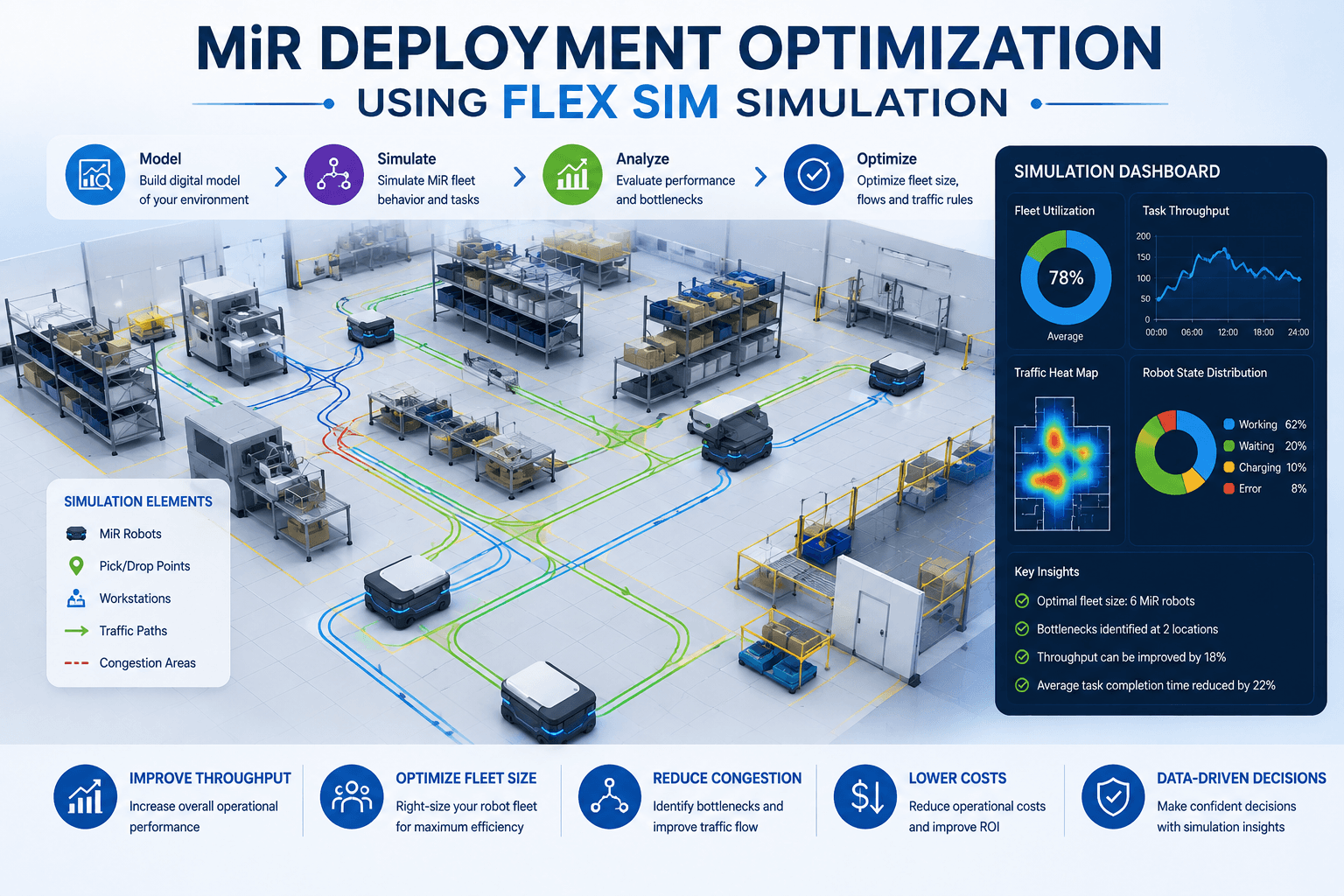
MNES developed a detailed FlexSim-based simulation model to analyse and optimize MiR deployment strategies within the manufacturing environment.
The simulation study included:
- Modelling of four Auto Bagging Machine (ABM) processes.
- Evaluation of single and dual MiR deployment scenarios.
- Simulation of MiR movement, routing, loading/unloading, and charging behaviour.
- Optimization of task prioritization and resource allocation.
- Analysis of throughput, utilization, idle time, and bottlenecks.
System Features
- FlexSim-Based Digital Twin: High-fidelity MiR deployment simulation mapped directly to physical constraints.
- Comparative Scenarios: Granular single and dual MiR performance comparison matrices.
- Dynamic Routing: Priority-based routing logic implementation for balanced task dispatching.
- Intelligent Battery Management: Opportunity charging strategy for continuous, shift-long operation.
- System Analytics: Throughput and utilization analysis across multiple simultaneous processes.
- Diagnostics: Bottleneck identification and process flow optimization.
- Temporal Tracking: Shift-based operational performance analysis integrating real-world MiR operational parameters.
Engineering & Optimization
A systematic engineering methodology was adopted to optimize MiR deployment and overall manufacturing performance. The project began with a detailed study of the client's existing production workflow, machine layout, transportation routes, and material movement between Auto Bagging Machines.
Based on this analysis, MN Engineering Solutions developed multiple simulation scenarios to compare operational performance under different deployment configurations. Both single and dual MiR systems were evaluated by analysing robot utilization, travel distance, waiting time, blocked time, queue formation, and throughput across different production shifts.
A priority-based routing strategy was implemented to ensure balanced task allocation among all production stations, particularly for longer travel routes serving ABM1L and ABM1R. The routing logic dynamically assigned transportation tasks according to production priority, robot availability, and travel distance, preventing congestion while maintaining continuous material flow.
Simulation Study & Performance Analysis
Comprehensive simulation studies were performed to evaluate the operational behaviour of autonomous mobile robots under different production scenarios. Key performance indicators, including throughput, cycle time, utilization, idle time, blocked time, queue length, and travel efficiency, were continuously monitored throughout the simulation.
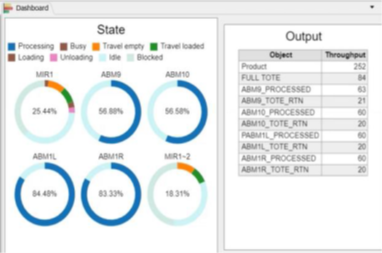
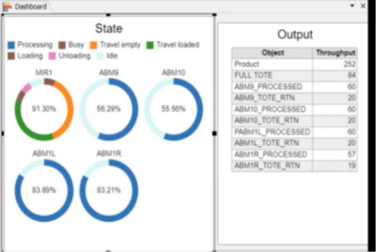
The comparative analysis demonstrated the operational advantages and limitations of both single and dual MiR deployment strategies. Simulation outputs revealed that introducing an additional MiR did not always increase productivity, as unnecessary robot interaction and traffic congestion occasionally reduced overall system efficiency.
The digital simulation model provided valuable insights into resource allocation, production balancing, and transportation efficiency without interrupting ongoing manufacturing operations. These findings enabled the client to confidently select the most effective deployment strategy based on measurable engineering data rather than assumptions.
MiR Charging & Routing Optimization
Efficient battery management and intelligent routing were essential to maximizing robot productivity. MN Engineering Solutions implemented an opportunity charging strategy that continuously monitored battery levels and automatically directed MiRs to charging stations whenever suitable idle periods became available.
Unlike conventional scheduled charging, this strategy minimized production interruptions by allowing robots to recharge only when operationally feasible. Combined with intelligent routing algorithms, the charging methodology significantly improved robot availability and reduced idle time.
The routing algorithm continuously optimized transportation paths based on production priority, task location, robot availability, and travel distance. This adaptive decision-making process minimized unnecessary movement, reduced congestion, and maintained uninterrupted material transportation throughout the manufacturing cycle.
Simulation with dual MiR
Simulation with solo MiR
Technology Stack
| Category | Technology / Tool Used |
|---|---|
| Simulation Platform | FlexSim |
| Autonomous Mobile Robot | MiR (Mobile Industrial Robot) |
| Simulation Methodology | Discrete Event Simulation (DES) |
| Production Equipment | Auto Bagging Machines (ABMs) |
| Material Handling | Autonomous Intralogistics |
| Optimization Techniques | Priority-Based Routing & Task Scheduling |
| Battery Management | Opportunity Charging Strategy |
| Performance Analysis | Throughput, Utilization, Idle Time, Blocked Time, Cycle Time |
| Engineering Activities | Process Modelling, Resource Allocation, Bottleneck Analysis, Production Optimization |
| Industry Domain | Smart Manufacturing / Industry 4.0 |
Testing & Validation
Following the development of the simulation model, extensive testing and validation were conducted to verify the accuracy of the simulated manufacturing environment. Multiple production scenarios were executed under different operating conditions to evaluate the performance of both single and dual MiR deployment strategies.
The engineering team validated robot movement, task sequencing, routing behaviour, charging logic, production flow, and communication between manufacturing resources within the simulation environment. Key performance indicators were continuously monitored and compared to identify the configuration that delivered the highest operational efficiency.
Simulation outputs confirmed the correctness of production logic, transportation sequences, and resource allocation while highlighting opportunities for process improvement. The validated simulation model provided the client with confidence that the recommended deployment strategy would achieve the expected operational performance before implementation on the production floor.
The Outcome or Results
By implementing the FlexSim-based simulation study, MNES enabled the client to optimize MiR deployment and significantly improve manufacturing operational efficiency.
Key results included:
Performance Breakthroughs
- Optimized MiR Deployment (CapEx Protection): Simulation results confirmed that a single MiR configuration delivered better operational efficiency compared to dual MiR deployment. MNES successfully protected the client from redundant capital investments by proving that a second fleet unit induced systemic congestion bottlenecks.
- Improved Resource Utilization: The single-MiR deployment achieved approximately 85% utilization while significantly reducing blocked and idle times.
- Reduced Idle Time: Strategic integration of the opportunity charging algorithm reduced MiR idle time by approximately 8%.
- Enhanced Throughput Performance: Optimized routing and dynamic task prioritization successfully stabilized and improved throughput consistency across all ABM processes.
- Root-Cause Bottleneck Identification: Simulation analysis identified underlying upstream delays impacting downstream operations, enabling targeted, long-term process improvement planning.
Conclusion
MN Engineering Solutions successfully optimized the deployment of Mobile Industrial Robots (MiRs) through a comprehensive FlexSim-based simulation study. By evaluating multiple deployment scenarios, implementing intelligent routing and charging strategies, and identifying operational bottlenecks, MNES enabled the client to make informed, data-driven decisions before physical implementation.
The project improved resource utilization, reduced idle time, enhanced material flow, and increased overall manufacturing efficiency while minimizing implementation risks. This case study demonstrates MNES's expertise in digital manufacturing, industrial automation, and simulation-driven optimization, delivering scalable Industry 4.0 solutions that support data-driven and highly efficient manufacturing operations.