

Customer Background
A leading U.S.-based HVAC equipment manufacturer specializing in high-performance industrial machinery was facing growing challenges in maintaining design consistency across multiple projects. The company regularly develops customized HVAC systems and machine components to meet diverse customer requirements, which demands frequent modifications to engineering models and manufacturing drawings.
As project volumes increased, the engineering team found itself spending significant time recreating similar designs, modifying existing models, and updating drawings manually. While the products shared common design characteristics, the absence of a standardized and flexible design framework resulted in inefficiencies throughout the engineering process.
To improve productivity, reduce design effort, and establish greater consistency across projects, the customer sought a solution that would enable engineers to generate models and drawings faster without compromising quality or accuracy.
The Challenge
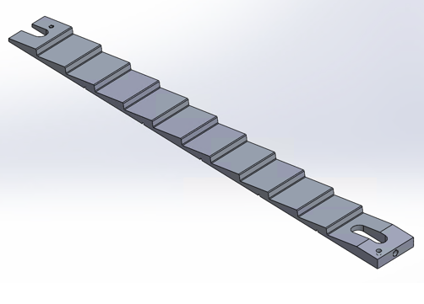
The customer's engineering team was responsible for designing upper and lower slide assemblies used across multiple HVAC machine configurations. Although the assemblies followed similar design principles, dimensional variations and customer-specific requirements often required engineers to create new models or extensively modify existing designs.
Without a standardized template system, several issues emerged:
- Inconsistent modelling practices between engineers and projects.
- Repetitive manual work during model creation.
- Increased risk of dimensional and documentation errors.
- Longer engineering lead times.
- Difficulty maintaining drawing standards across product variants.
- Higher levels of rework during design reviews and manufacturing preparation.
Engineers frequently spent time updating dimensions, editing sketches, modifying features, and recreating drawings that were fundamentally similar to previous designs. These repetitive activities consumed valuable engineering resources that could otherwise be focused on innovation and product development.
As the number of customer-specific configurations increased, the company recognized the need for a scalable engineering methodology capable of supporting rapid design customization while maintaining consistency across all deliverables.
The company recognized the need for a scalable engineering methodology capable of supporting rapid design customization while maintaining consistency across all deliverables.
Engineering Objectives
The primary objective was to create a flexible and intelligent design framework that would allow engineers to generate multiple design variants from a common template.
The solution needed to:
- Standardize modelling practices.
- Reduce manual design effort.
- Accelerate drawing generation.
- Improve design consistency.
- Minimize engineering errors.
- Support future product variations without extensive redesign.
The customer also wanted a system that could be easily adopted by engineers without requiring complex programming or specialized software development.
MN Engineering Solutions Approach
MN Engineering Solutions developed a parametric SolidWorks template framework designed to automate model creation and drawing generation through controlled design parameters.
Rather than creating new models for every project, the solution enabled engineers to modify a small set of predefined parameters that automatically updated the entire model and associated drawings.
The approach focused on creating a reusable engineering platform that could support multiple product configurations while maintaining design standards and reducing manual effort.
Development of Parametric Models
The first phase involved analyzing existing HVAC slide designs to identify common features, dimensional relationships, and recurring design patterns.
Based on this assessment, engineers developed highly flexible parametric SolidWorks models.
Key design elements included:
- Fully constrained sketches.
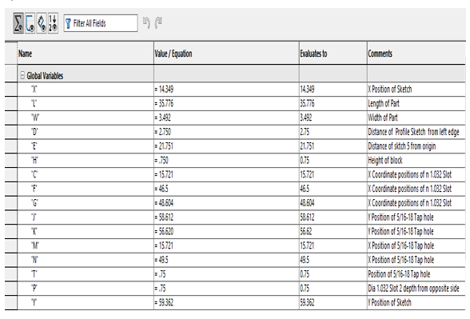
- Equation-driven dimensions.
- Linked design parameters.
- Intelligent feature relationships.
- Automated geometry updates.
Critical dimensions were connected through equations that controlled the overall geometry of the model. By changing a small number of input values, engineers could automatically generate new design variants without manually modifying individual features.
This parametric approach ensured that all dependent dimensions and relationships remained accurate regardless of design size or configuration.
Establishing a Template-Based Design Framework
To simplify model customization, MN Engineering Solutions created a structured template system that guided users through the modification process.
A reference model was developed with clearly defined parameters and instructions for updating equation values. Engineers could create new configurations simply by entering a few key dimensions, allowing the system to automatically regenerate the model geometry.
This eliminated the need for extensive CAD modifications and reduced dependency on advanced modelling expertise.
The template framework also ensured that all generated models followed the same engineering standards, improving consistency across projects and engineering teams.
Automated Drawing Generation
One of the most significant productivity improvements came from automating the drawing creation process.
Traditionally, creating manufacturing drawings involved manually placing views, updating dimensions, revising annotations, and validating documentation. This process was both time-consuming and prone to human error.
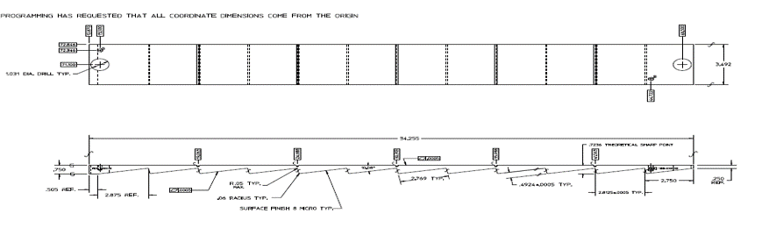
MN Engineering Solutions developed drawing templates directly linked to the parametric master models.
As model dimensions changed, the drawing templates automatically updated:
- Orthographic views.
- Section views.
- Dimensions.
- Annotations.
- General notes.
- Title block information.
This capability significantly reduced the effort required to produce manufacturing-ready documentation while ensuring accuracy between the model and drawing.
Improved Design Standardization
Beyond productivity improvements, the template framework established a consistent engineering methodology across the organization.
Every generated model and drawing followed predefined design standards, reducing variation between projects and improving documentation quality.
MN Engineering Solutions developed drawing templates directly linked to the parametric master models.
Benefits included:
- Consistent CAD modelling practices.
- Standardized drawing layouts.
- Improved manufacturing documentation.
- Easier design reviews.
- Better knowledge retention across engineering teams.
This standardization also simplified onboarding for new engineers, as they could quickly understand and utilize the template-based workflow.
Results and Business Impact
The implementation of the parametric template framework delivered immediate and measurable improvements to the customer's engineering operations.
By replacing manual modelling and drafting activities with an automated, equation-driven process, engineers were able to generate new designs significantly faster than before.
Key outcomes included:
- Rapid creation of new part models using minimal input parameters.
- Automatic generation of associated manufacturing drawings.
- Improved design consistency across projects.
- Reduced engineering effort for repetitive design tasks.
- Lower risk of modelling and documentation errors.
- Faster project execution and design release cycles.
Most notably, the customer achieved nearly a 50% reduction in model and drawing creation time compared to the traditional approach of building designs from scratch.
Conclusion
Through the development of a flexible SolidWorks template framework, MN Engineering Solutions helped the customer transform a repetitive and time-intensive engineering process into a streamlined, standardized workflow.
By leveraging parametric modelling, equation-driven design, and automated drawing generation, the solution enabled faster design execution, improved consistency, and reduced engineering effort across multiple HVAC projects.
The result was a scalable design platform that not only improved productivity but also established a foundation for future engineering automation initiatives, allowing the customer to respond more quickly to project demands while maintaining high standards of quality and accuracy.