


Customer Credentials
The customer is a leading North American specialty vehicle manufacturer specializing in the design and manufacture of emergency response vehicles across multiple commercial truck platforms. Their product portfolio includes numerous ambulance variants designed to satisfy diverse customer requirements while maintaining high standards of safety, manufacturability, and engineering quality.
Over several years, the organization had developed a vast library of vehicle-specific engineering data, including action area panels used throughout different vehicle programs. These panels served as critical operator interfaces, housing controls, switches, indicators, and other electrical components required during vehicle operation. As new customer programs evolved, panel designs were frequently modified to accommodate varying truck platforms, customer preferences, and equipment packages. While this enabled customization, it also resulted in a growing number of similar yet independently developed panel assemblies.
The engineering team recognized that much of this design effort was repetitive and that a significant opportunity existed to standardize panel configurations without compromising customer flexibility. To address this challenge, MN Engineering Solutions (MNES) was engaged to analyze historical engineering data and establish a standardized action area panel strategy that could be applied across the customer's standard vehicle platforms.
Situation / Challenge
Action area panels are among the most visible and frequently used assemblies within a specialty vehicle. They integrate electrical controls, emergency switches, displays, communication interfaces, and operator functions into a compact and ergonomically accessible location. Over time, the customer had accumulated a large number of panel designs across multiple vehicle programs. Although many panels appeared different, a detailed engineering review revealed that a considerable portion of their layouts, mounting arrangements, and functional architecture were highly similar.
These similarities had never been systematically analyzed. Instead, each new vehicle program often resulted in development of a new panel model, minor modifications to existing designs, independent documentation, separate engineering validation, and additional drawing maintenance.
As the engineering database expanded over several years, identifying reusable panel designs became increasingly difficult. Engineers frequently searched through thousands of historical design files to determine whether an existing panel could be reused or whether a new design should be created. The absence of a standardized panel library resulted in increasing engineering complexity despite relatively small differences between many panel configurations. The organization needed an engineering methodology capable of distinguishing true design uniqueness from unnecessary duplication.
The organization needed an engineering methodology capable of distinguishing true design uniqueness from unnecessary duplication.
Implications
The growing number of action area panel designs affected several aspects of product development.
Engineering Efficiency
Engineers invested significant effort in reviewing historical drawings before beginning new designs. Because similar panels were stored under different projects, identifying reusable assemblies became increasingly time-consuming.
This often resulted in duplicate design activities, increased modeling effort, additional documentation, and longer engineering lead times.
Configuration Complexity
Multiple versions of similar panels created unnecessary configuration complexity. Small differences in switch placement, cut-out geometry, mounting arrangements, and component positioning often resulted in entirely separate engineering models.
This increased the overall number of maintained engineering assemblies while providing limited functional benefit.
Manufacturing Challenges
Production teams were required to manage multiple panel variants that differed only slightly. This increased manufacturing documentation, assembly interpretation, production planning effort, and inventory management complexity.
Greater variation also reduced opportunities for repeatable manufacturing processes.
Procurement & Knowledge Management
A larger variety of panel assemblies translated into additional purchasing complexity. Procurement teams needed to manage multiple part numbers and associated components, making sourcing and inventory planning more difficult.
Years of accumulated engineering information contained valuable organizational knowledge. However, without structured analysis, this information remained largely inaccessible. The organization required a systematic method to transform historical engineering data into reusable design intelligence.
Solution Implemented by MNES
Rather than approaching the project as a conventional standardization exercise, MNES adopted a data-driven engineering methodology focused on identifying reusable design patterns.
Historical Engineering Data Analysis
The project began with an extensive analysis of several years of historical engineering records. Thousands of engineering files, assemblies, and drawings were reviewed to understand panel usage frequency, platform compatibility, functional similarities, layout commonality, component placement trends, and customer-specific variations.
Instead of evaluating panels individually, MNES analyzed them collectively to identify recurring engineering patterns. This analytical approach revealed that many panel designs shared common structural and functional characteristics despite being documented as separate engineering assemblies.
Standard Design Families & Library
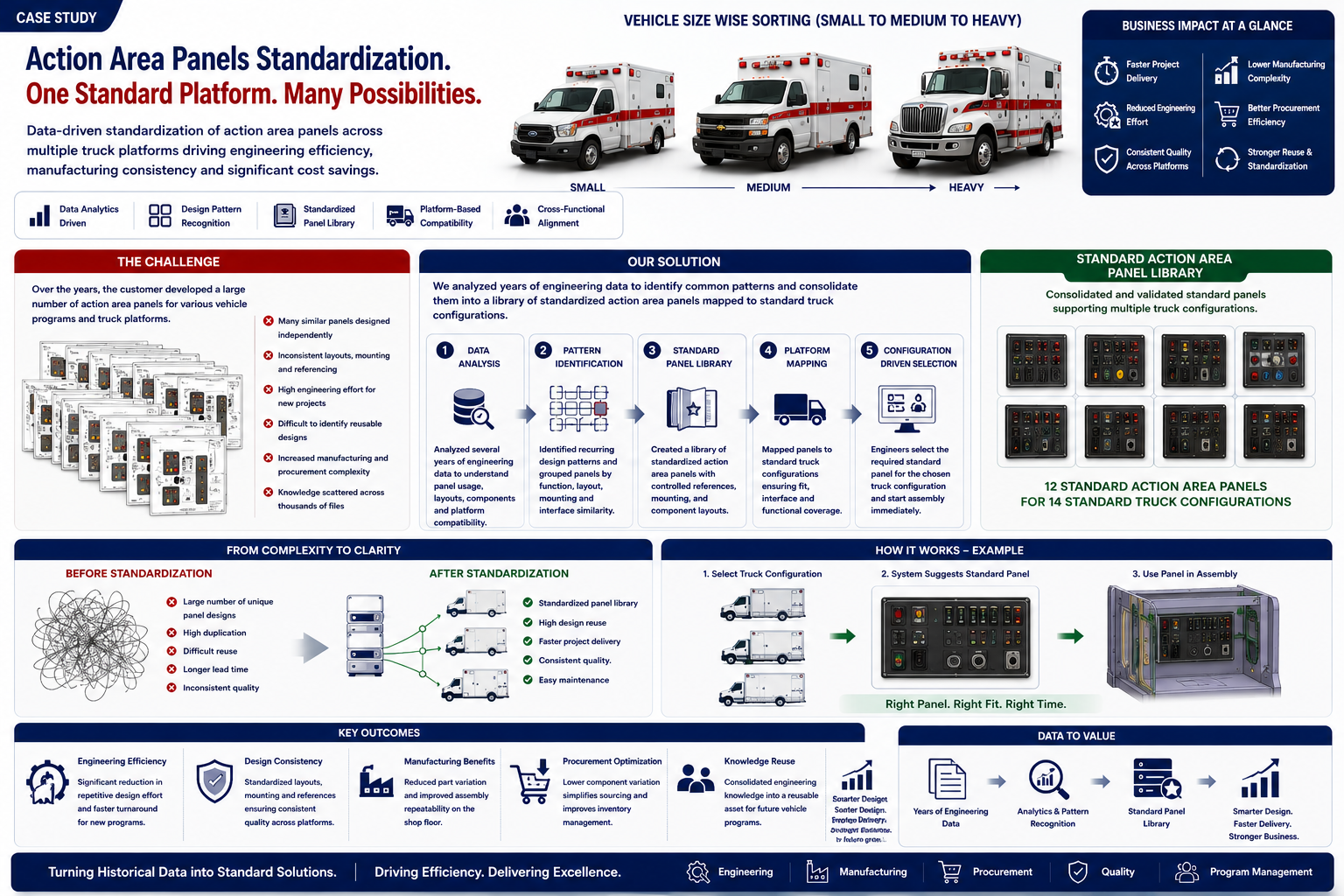
Based on the engineering analysis, panels were grouped into standardized design families according to vehicle platform compatibility, functional requirements, mounting architecture, interface locations, and electrical component arrangement. Rather than maintaining numerous independent panel models, MNES established a consolidated library of standardized action area panels capable of supporting the customer's standard truck configurations.
A centralized library of approved standard panels was created. Each panel included standardized mounting interfaces, controlled reference geometry, consistent documentation, common engineering practices, and platform-specific compatibility.
This transformed the engineering approach from:
Platform-Based Configuration Strategy
The standardized panels were mapped against the organization's standard truck configurations. This created a repeatable engineering framework where panel selection became configuration-driven rather than project-driven. As a result, engineering reuse increased substantially, configuration management became significantly simpler, and future vehicle programs could leverage existing validated designs.
Outcome
The implementation delivered significant improvements across engineering, manufacturing, procurement, and configuration management.
Engineering & Manufacturing Improvements
The standardized panel library substantially reduced repetitive engineering effort. Instead of reviewing large volumes of historical files, engineers could quickly identify the appropriate standardized panel for each vehicle configuration.
- Faster project initiation
- Increased design reuse
- Reduced duplicate modeling
- Improved engineering productivity
- Greater manufacturing repeatability
- Reduced interpretation differences during assembly
Configuration & Strategic Benefits
Simplified Configuration Management
The transition from numerous individual panel designs to a structured family of standardized panels simplified configuration management. Engineers could work from a controlled set of validated designs rather than maintaining numerous project-specific variations.
Procurement Optimization
Reduced design variation enabled improved purchasing consistency. Standardized panels simplified component planning and reduced unnecessary complexity in inventory management.
Better Knowledge Utilization
One of the most valuable outcomes was the transformation of historical engineering data into actionable design intelligence. Rather than serving as archived documentation, years of engineering knowledge became a reusable organizational asset.
Strategic Foundation
The project established a strong foundation for future initiatives involving platform engineering, modular product development, design automation, digital configuration management, and engineering knowledge reuse.
Conclusion
This project demonstrated that engineering standardization is not simply about reducing the number of designs—it is about identifying opportunities to maximize design reuse while preserving product flexibility.
By applying comprehensive historical data analytics and engineering pattern recognition, MNES transformed years of disconnected panel designs into a structured, standardized panel ecosystem aligned with the customer's vehicle platforms.
What initially appeared to be a design consolidation exercise evolved into a strategic engineering initiative that strengthened configuration management, simplified manufacturing, improved procurement efficiency, and enhanced cross-functional collaboration.
Most importantly, the project showcased how historical engineering data, when properly analyzed, can become one of an organization's most valuable assets—driving smarter design decisions, accelerating future product development, and creating a scalable foundation for continued engineering excellence.