


Customer Credentials
The customer is a leading North American specialty vehicle manufacturer engaged in designing and manufacturing emergency response vehicles across multiple vehicle platforms. Their product portfolio includes various vehicle configurations built on different truck chassis and tailored to diverse customer requirements.
The organization serves multiple end users, each with unique expectations regarding emergency warning systems, exterior lighting layouts, visibility requirements, and vehicle appearance. Their manufacturing operations involve close coordination among engineering, sales, procurement, and production teams to ensure that every vehicle complies with applicable standards while meeting customer-specific requirements.
With increasing product variants and customization demands, maintaining consistency in exterior lighting configurations became increasingly challenging. The customer sought support for generating exterior emergency lighting compliance reports and validating multiple vehicle configurations against established industry and organizational standards.
MN Engineering Solutions (MNES) partnered with the customer to support this requirement.
Situation / Challenge
Exterior emergency lighting systems on specialty vehicles are often perceived simply as visibility components. However, for vehicle manufacturers, these systems represent a much broader engineering and operational responsibility. Exterior lighting directly influences:
The customer operated multiple vehicle programs involving:
- Multiple truck chassis platforms
- Different body configurations
- Customer-specific lighting preferences
- Multiple emergency warning light combinations
- Distinct exterior layouts
Every lighting configuration had to undergo validation to ensure:
- Proper luminous performance
- Visibility compliance
- Adherence to AMD standards
- Compliance from all viewing angles and vehicle sides
Initially, the requirement appeared straightforward: generate compliance reports for the lighting configurations.
However, a deeper investigation revealed a larger operational issue — engineering teams were repeatedly performing identical activities across multiple projects:
- Selecting light combinations
- Configuring warning devices
- Performing compliance checks
- Validating luminous performance
- Reworking failed configurations
- Repeating validations for similar layouts
Although the final objective remained the same, the validation effort was being repeated across projects, consuming significant engineering time.
Simultaneously, other departments faced their own challenges.
Sales teams required faster methods to present lighting options to customers.
Procurement teams needed clarity regarding approved configurations and associated components.
Production teams required consistent assembly information to avoid interpretation errors.
As vehicle variants and customer options increased, the complexity of managing lighting configurations grew substantially.
Implications
The repetitive validation process created several operational challenges throughout the organization.
Engineering Impact
Engineering resources were heavily consumed by repetitive compliance activities. Similar lighting layouts were often analyzed multiple times across different projects, reducing the team's ability to focus on higher-value design activities.
Repeated validation cycles resulted in:
- Increased engineering workload
- Longer project lead times
- Higher risk of manual errors
- Reduced productivity
Sales Impact
Sales teams often lacked standardized, approved lighting configurations to present during customer discussions.
As a result:
- Customer decisions were delayed.
- Engineering support was frequently required during sales activities.
- Multiple iterations were needed before finalizing customer requirements.
Procurement Impact
Without standardized configurations, procurement teams struggled to identify approved lighting components.
This resulted in:
- Ordering ambiguities
- Increased risk of part mismatches
- Difficulty maintaining supplier consistency
- Challenges in inventory planning
Production Impact
Manufacturing teams encountered interpretation issues during assembly due to varying, non-standard configurations.
The absence of standardized lighting packages led to:
- Increased assembly complexity
- Reduced repeatability
- Potential installation inconsistencies
- Additional clarification requirements
Overall, the organization was experiencing operational inefficiencies caused not by technology limitations, but by the absence of a structured configuration management system.
Solution Implemented by MNES
Rather than treating every lighting validation request as an independent compliance activity, MNES adopted a broader analytical approach.
Historical Data Analysis
MNES studied nearly five years of historical production and engineering data to identify recurring patterns.
The analysis focused on:
- Frequently used vehicle models
- Common customer selections
- Repetitive lighting layouts
- Previously successful configurations
- Compliance history
This exercise revealed that a significant percentage of lighting combinations had already been successfully validated in previous programs.
Development of a Standardized Configuration Framework
Based on the findings, MNES developed a structured lighting configuration framework.
Instead of validating random combinations for every new vehicle, multiple pre-approved configurations were established for different vehicle platforms and variants.
Each standardized configuration was:
- Structurally organized
- Compliance validated
- Luminous performance verified
- Quality checked
- Production ready
This transformed the engineering process from:
Centralized Configuration Selection System
MNES further enhanced the process by developing a centralized configuration selection approach.
The system enabled multiple departments to benefit from the same approved configuration database.
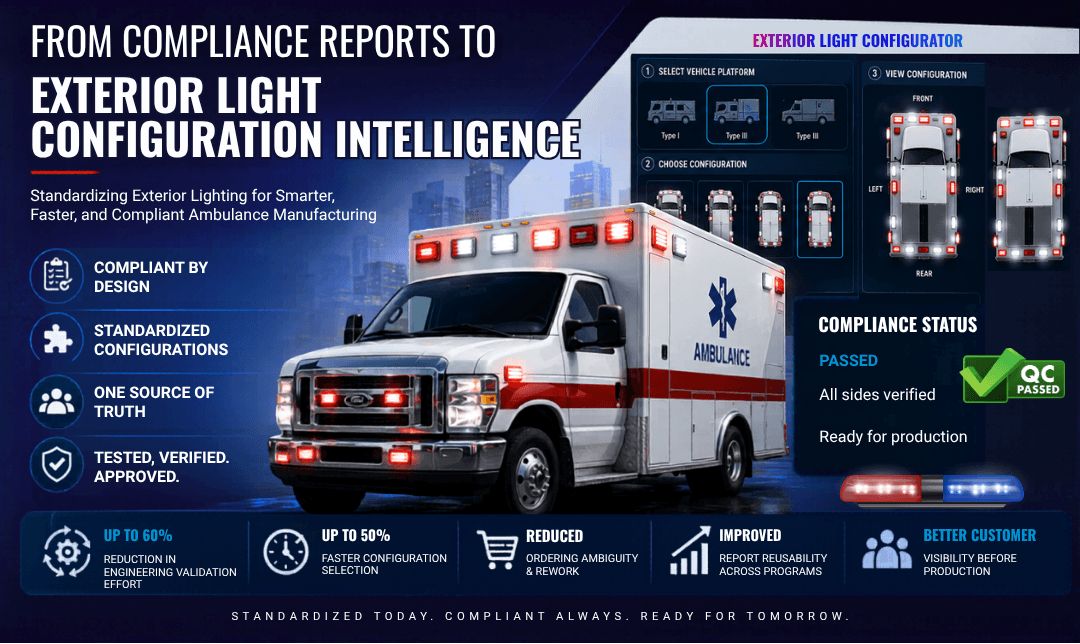
Benefits Across Departments
For Sales Teams
Sales personnel could now present approved lighting options directly to customers.
Benefits included:
- Improved customer visualization
- Faster decision-making
- Reduced engineering dependency
- Better communication of options
For Engineering Teams
Engineering teams could reuse validated configurations.
This resulted in:
- Reduced validation effort
- Less repetitive analysis
- Lower rework requirements
- Faster project execution
For Procurement Teams
Standardized configurations improved Bill of Material clarity.
Advantages included:
- Better sourcing consistency
- Reduced ordering errors
- Improved supplier communication
- Enhanced inventory planning
For Production Teams
Production personnel benefited from improved assembly consistency.
The standardized configurations enabled:
- Better repeatability
- Reduced interpretation issues
- Improved assembly quality
- More consistent installations
Outcome
The project delivered benefits across engineering, sales, procurement, and manufacturing functions.
Quantitative Improvements
The implementation resulted in:
- Significant reduction in repetitive engineering validation activities
- Faster configuration selection during new projects
- Improved report reuse across multiple programs
- Reduced ambiguity in component selection
- Improved production consistency
- Reduced engineering rework cycles
- Better utilization of engineering resources
Qualitative Improvements
Improved Cross-Functional Collaboration
A common platform for engineering, sales, procurement, and manufacturing teams.
Enhanced Customer Experience
Customers review approved configurations earlier in the sales cycle, for faster decisions and more confidence.
Faster Engineering Decisions
Teams focus on new challenges instead of revalidating previously approved solutions.
Better Configuration Management
A structured approach to managing lighting options and compliance requirements.
Reduced Operational Complexity
Standardized solutions minimize uncertainty and manual interpretation across departments.
Conclusion
This project demonstrated that operational improvements do not always require new technologies or complex software solutions.
Sometimes the greatest value comes from:
- Standardization
- Configuration intelligence
- Process optimization
- Historical data utilization
- Cross-functional alignment
What initially began as a lighting compliance reporting activity evolved into a scalable configuration ecosystem that supported multiple departments and improved organizational efficiency.
By transforming repetitive compliance tasks into reusable engineering assets, MNES helped the customer establish a smarter, more consistent, and highly scalable approach to specialty vehicle lighting configuration management.