


Customer Credentials
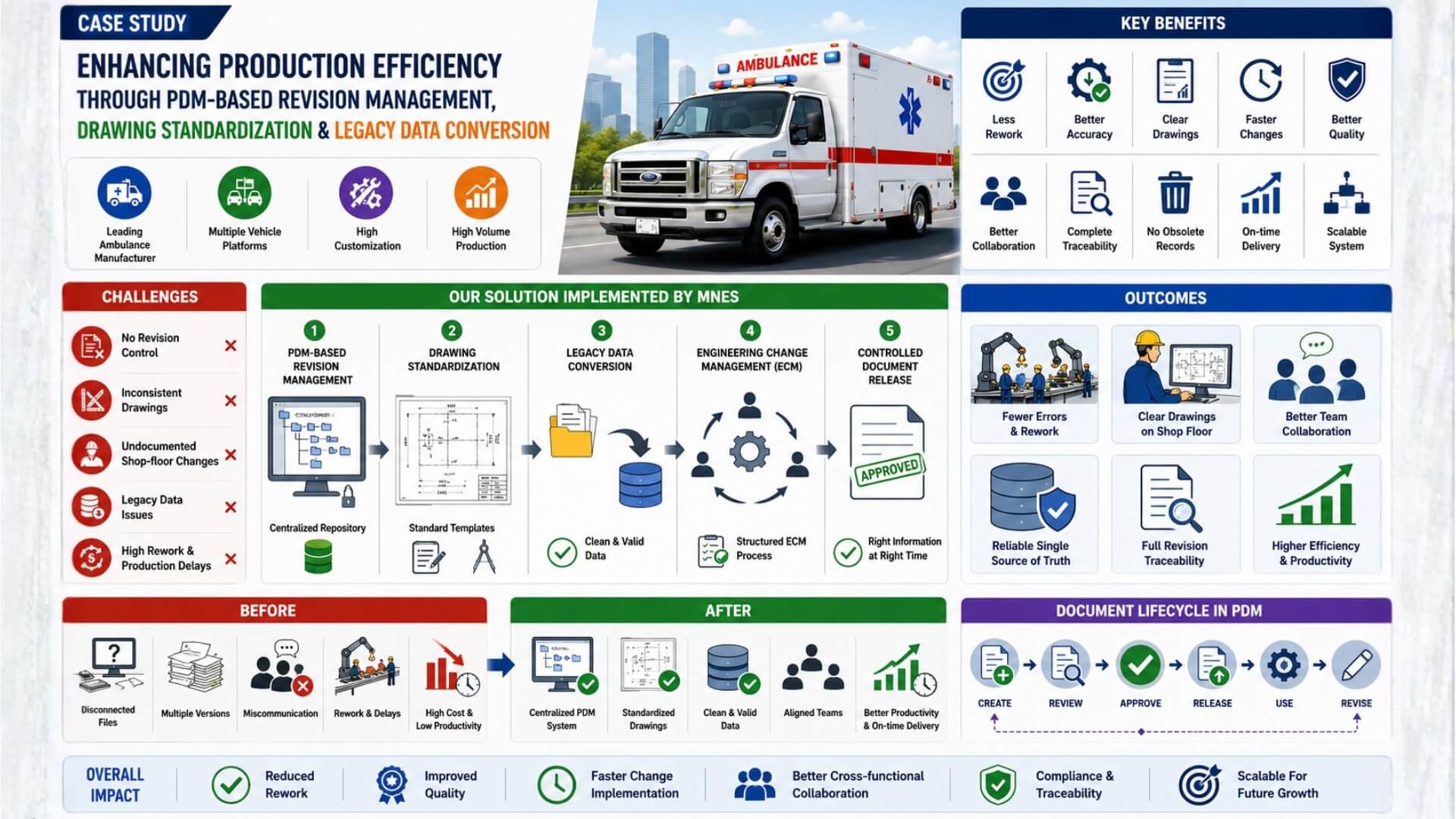
The customer is a leading ambulance manufacturer specializing in the design and production of emergency response vehicles for healthcare providers, municipalities, and public safety organizations. With a broad portfolio of vehicle platforms and increasing levels of customization, the company manages a large volume of engineering drawings, manufacturing documentation, and product configurations.
As production volumes increased, the organization faced growing challenges related to revision control, engineering documentation, and cross-functional communication. To address these challenges, the customer partnered with MN Engineering Solutions (MNES) to establish a structured framework for product data management, engineering change control, and documentation standardization.
Situation / Challenge
The customer's engineering and manufacturing teams relied on a combination of manually managed drawings, disconnected revision records, and legacy design documents. As product complexity and customization requirements increased, managing engineering data became increasingly difficult.
One of the primary challenges was the absence of a formal revision control process. Design modifications made during development or production were often communicated informally and were not consistently reflected in official engineering documentation. Drawing inconsistency was another major concern, with varying dimensioning practices, tolerance schemes, and annotation methods making interpretation difficult for production personnel.
The organization also struggled with undocumented shop-floor modifications. Practical changes implemented during production were not always incorporated into master engineering records, resulting in recurring mistakes and confusion. These challenges led to frequent rework cycles, material wastage, additional labor costs, and schedule delays. The customer required a comprehensive solution that would establish revision control, standardize engineering documentation, improve traceability, and create a centralized repository for engineering data.
The customer required a comprehensive solution that would establish revision control, standardize engineering documentation, improve traceability, and create a centralized repository for engineering data.
Implications
Production & Quality Risks
Without corrective action, the organization risked continued increases in production costs, quality issues, and delivery delays. The lack of structured revision management created uncertainty on the shop floor and increased the likelihood of manufacturing products to outdated specifications.
Documentation Confidence
Inconsistent drawings and undocumented changes reduced confidence in engineering documentation and made troubleshooting more difficult. Production teams often faced ambiguity when interpreting designs, resulting in avoidable errors and rework.
Legacy Data Complications
The accumulation of legacy engineering data further complicated operations, making it difficult to identify the latest approved documents and maintain consistency across departments.
Need for Scalable System
To support future growth and operational excellence, the customer needed a scalable system capable of managing engineering data throughout the product lifecycle while ensuring that all stakeholders worked from accurate and up-to-date information.
Solution Implemented by MNES
MN Engineering Solutions conducted a detailed assessment of the customer’s engineering workflows, documentation practices, and manufacturing processes to identify the root causes of recurring issues.
PDM-Based Revision Management System
MNES implemented a Product Data Management (PDM) system to serve as the central repository for all engineering documents and product information.
The system introduced controlled workflows for document creation, review, approval, and release. Every engineering change was assigned a revision level and tracked throughout its lifecycle, ensuring complete visibility and traceability of design modifications.
The PDM platform provided a single source of truth for engineering information, ensuring that design, manufacturing, quality, and procurement teams always had access to the latest approved documents.
To support successful adoption, MNES conducted training programs focused on revision management best practices, document control procedures, and effective utilization of the new system.
Drawing Standardization & Tolerance Management
Eliminate inconsistencies in engineering documentation, MNES developed and implemented company-wide drawing standards.
Standardized templates were introduced covering title blocks, dimensioning conventions, revision blocks, geometric dimensioning and tolerancing (GD&T), and annotation practices. Existing drawings were systematically reviewed and updated to align with the new standards.
Special attention was given to identifying missing tolerances, inconsistent callouts, and ambiguous manufacturing instructions. The resulting improvements significantly enhanced drawing clarity and reduced interpretation errors on the shop floor.
Legacy Data Conversion & Validation
A structured legacy data conversion initiative was undertaken to address years of accumulated engineering records.
MNES reviewed historical drawings, CAD models, and engineering documents to identify obsolete, duplicate, and conflicting information. Valid records were verified, corrected where necessary, and migrated into the PDM system.
This effort established a clean and reliable engineering database while eliminating confusion caused by multiple document versions. The migration also ensured that future projects would be built upon validated and controlled engineering information.
Engineering Change Management Process
Beyond technology implementation, MNES established a formal Engineering Change Management (ECM) process.
A structured workflow was created to govern the initiation, review, approval, and implementation of engineering changes. Cross-functional reviews involving engineering, manufacturing, quality, and procurement teams ensured that design changes were evaluated from all perspectives before release.
Controlled document release procedures were also implemented to prevent outdated drawings from reaching production, ensuring complete alignment between engineering intent and manufacturing execution.
Outcome
The implementation delivered substantial improvements in engineering efficiency, manufacturing accuracy, and cross-functional collaboration.
PDM-based revision management system established complete traceability for engineering changes and eliminated many of the challenges associated with outdated or uncontrolled documentation. Production teams gained confidence in the accuracy of released drawings, resulting in fewer manufacturing errors and reduced rework.
Standardized drawing practices improved communication between engineering and manufacturing personnel while enhancing quality control and inspection activities. Consistent GD&T and tolerance management reduced ambiguity and improved overall manufacturability.
The legacy data conversion initiative created a centralized and reliable engineering database, enabling faster access to accurate design information and eliminating confusion caused by obsolete records.
The newly established engineering change management process improved coordination across departments and ensured that all design modifications were reviewed, approved, and documented before implementation.
Key Benefits Achieved
- Significant reduction in production rework and engineering errors.
- Improved drawing clarity through standardized templates and GD&T practices.
- Complete traceability of design revisions and engineering changes.
- Enhanced collaboration between engineering, manufacturing, quality, and procurement teams.
- Elimination of duplicate and obsolete engineering records.
- Improved manufacturing accuracy and first-pass yield.
- Faster engineering change implementation and approval cycles.
- Better compliance with internal quality management requirements.
- Improved schedule adherence and on-time project delivery.
- Creation of a scalable engineering data management framework for future growth.
Conclusion
By implementing a PDM-based revision management system, standardizing engineering documentation, establishing a formal engineering change management process, and converting legacy data into a centralized repository, MN Engineering Solutions helped the customer significantly improve production efficiency and document control.
The initiative reduced rework, strengthened communication between departments, improved manufacturing accuracy, and established a robust digital foundation for future product development. The result was a more efficient, scalable, and quality-focused engineering environment capable of supporting continued business growth and operational excellence.