


Customer Credentials
The customer is a leading North American specialty vehicle manufacturer specializing in the design and manufacture of Type I, Type II, and Type III ambulances built on multiple commercial truck chassis platforms. Their engineering organization develops numerous vehicle variants every year, each requiring the integration of truck chassis, sub-assemblies, body structures, medical interiors, electrical systems, and customer-specific equipment.
The organization manages several truck platforms from different OEMs, each having unique wheelbases, cab configurations, frame dimensions, and mounting interfaces. Over the years, multiple engineering teams had independently developed truck space assemblies to support various customer programs.
Although these assemblies enabled successful vehicle development, they lacked a common engineering foundation. Each assembly evolved differently, resulting in inconsistent reference geometry, varying assembly methodologies, and increased dependence on individual designer experience.
Recognizing the need for a scalable and standardized engineering approach, the customer partnered with MN Engineering Solutions (MNES) to establish a unified truck space assembly framework capable of supporting future vehicle development while improving engineering efficiency and cross-functional consistency.
Situation / Challenge
Truck space assemblies form the backbone of every specialty vehicle design. They establish the primary coordinate system, define mounting interfaces, and serve as the reference for all downstream engineering activities. However, the customer's existing engineering environment had developed organically over several years. Each truck platform contained independently created assemblies with varying modeling practices.
One of the most significant challenges was the absence of standardized engineering references. Most truck assemblies did not include standardized datum structures, common reference planes, consistent coordinate systems, uniform assembly origins, or controlled reference geometry. Instead, designers created reference planes and datums individually whenever a new project began.
Every new ambulance program required engineers to spend valuable time recreating primary reference planes, vehicle centerlines, chassis interface datums, assembly coordinate systems, and mounting reference geometry. Since these references depended largely on individual interpretation, consistency varied from project to project.
As vehicle variants increased, maintaining engineering repeatability became increasingly difficult. Additionally, modifications requested later in the product lifecycle often required engineers to understand how each assembly had originally been constructed before implementing changes. The customer required a standardized solution that would eliminate repetitive setup activities while creating a common engineering framework for every future vehicle program.
The customer required a standardized solution that would eliminate repetitive setup activities while creating a common engineering framework for every future vehicle program.
Implications
The lack of standardized reference geometry affected several engineering and operational functions.
Engineering Productivity
Engineers invested considerable time establishing reference geometry before actual design work could begin. Typical setup activities included creating base datum structures, defining assembly origins, establishing vehicle centerlines, generating construction planes, and creating mounting references.
Engineering estimates showed that approximately 3 to 6 engineering hours were consumed during the initial setup of each new truck platform before productive design activities could begin. Across dozens of annual projects, this represented a significant loss of engineering capacity.
Design Consistency
Because each engineer created reference geometry independently, assemblies often differed in coordinate system orientation, plane naming conventions, reference hierarchy, parent-child relationships, and feature dependency structures.
This reduced design standardization and made collaboration more difficult.
Modification Challenges
Engineering changes are common throughout specialty vehicle development. Without standardized datums, implementing modifications required engineers to first understand the modeling methodology used in each individual assembly.
This increased design review effort, modification time, risk of reference failures, and assembly regeneration issues.
Cross-Functional Impact
The absence of common engineering references also affected downstream teams. Manufacturing engineers, quality teams, and future design engineers lacked a consistent reference framework for measurement locations, assembly interfaces, design reviews, and future platform upgrades.
The organization recognized that standardization was essential not only for current projects but also for long-term product lifecycle management.
Solution Implemented by MNES
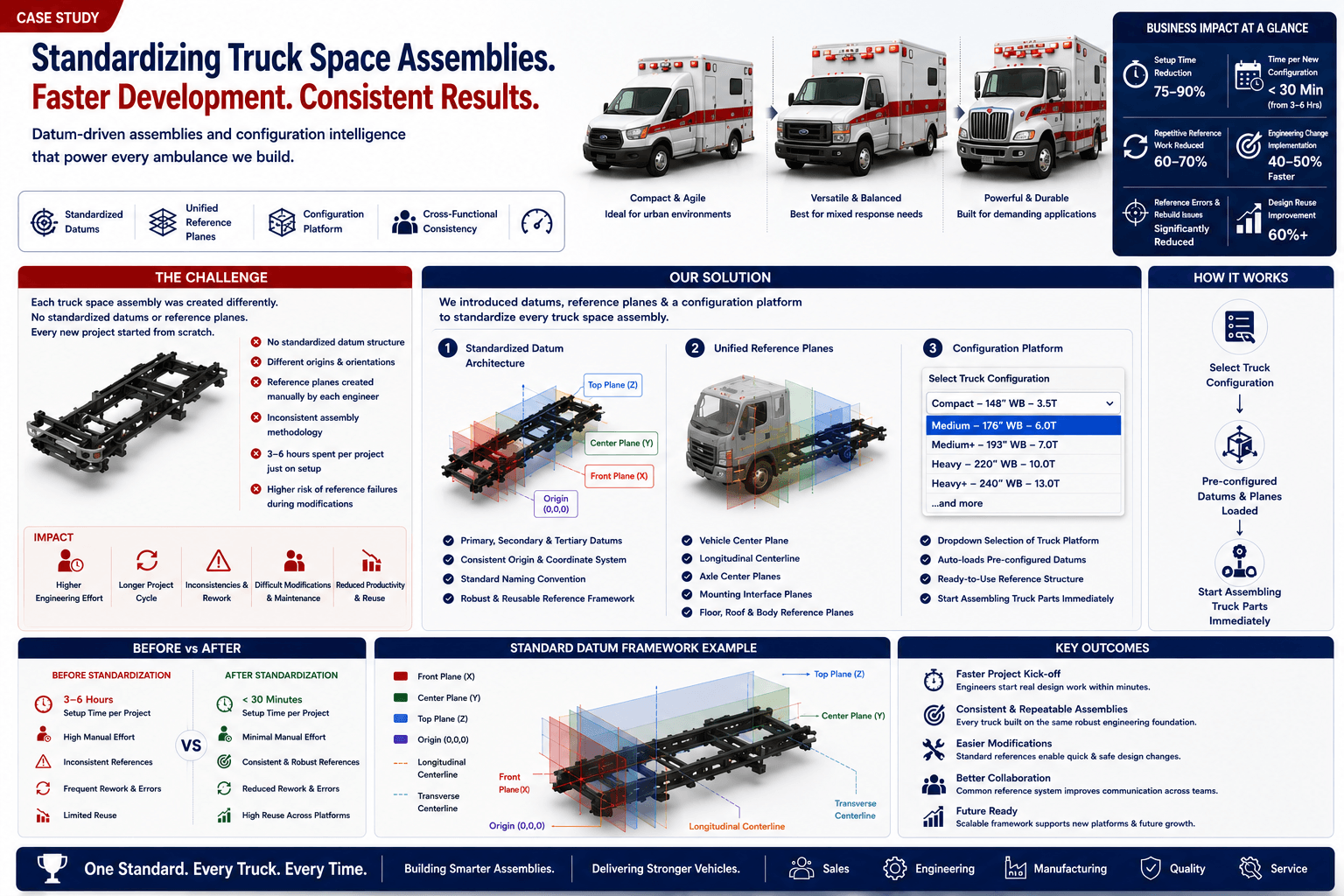
Rather than simply updating existing truck assemblies, MNES developed a comprehensive engineering standardization framework centered around datum-driven design principles and parametric configuration management.
Standardized Datum Architecture
The first phase involved defining a common engineering reference structure applicable across all truck platforms. Each truck space assembly was redesigned to include standardized primary datums, secondary datums, tertiary reference geometry, vehicle center planes, longitudinal centerlines, cross-sectional reference planes, chassis mounting reference planes, and assembly coordinate systems.
A consistent naming convention was established to ensure every engineer could immediately understand the reference structure regardless of the vehicle platform.
Parametric Configuration Platform
To further improve engineering efficiency, MNES developed an intelligent configuration platform that automated the selection of truck-specific assembly templates. Instead of manually constructing a new truck space assembly, engineers could simply select the required truck platform from a predefined configuration list.
The system automatically generated the corresponding truck space assembly with predefined datum structures, standard reference planes, vehicle coordinate systems, interface geometry, and platform-specific engineering references.
This transformed the engineering approach from:
Standardization of Reference Planes
MNES introduced predefined reference planes positioned according to vehicle architecture rather than individual designer preferences. These reference planes represented critical engineering locations such as front axle center, rear axle center, cab interface, body mounting interfaces, floor reference, roof reference, vehicle centerline, and symmetry planes. As a result, downstream assemblies could reference standardized geometry instead of creating new references for every project.
Outcome
The implementation transformed the customer's truck space assembly development process from an engineer-dependent methodology into a standardized engineering platform.
Quantitative Improvements
The project delivered several measurable engineering benefits.
- 75–90% reduction in truck assembly setup time through reusable reference frameworks
- Reduction of initial assembly preparation effort from 3–6 hours to less than 30 minutes per new truck configuration
- Approximately 60–70% reduction in repetitive reference geometry creation
- 40–50% faster implementation of engineering modifications due to standardized datum structures
- Significant reduction in assembly reference errors and failed feature rebuilds
- Improved design reuse across multiple vehicle platforms
Qualitative Improvements
Engineering Benefits
Engineers could immediately begin designing vehicle structures rather than preparing assembly foundations. The standardized datum architecture provided faster project initiation, improved design consistency, simplified assembly management, better model robustness, and easier design reviews.
Improved Repeatability
Every truck platform now followed identical engineering principles. This created consistent reference geometry, predictable assembly behavior, improved design repeatability, and easier knowledge transfer between engineers.
Simplified Engineering Changes
Because every assembly shared the same datum structure, engineers could implement design changes with greater confidence while minimizing dependency failures. Future updates, platform enhancements, and customer-specific modifications became considerably easier to manage.
Cross-Functional Advantages
Manufacturing, quality, and project teams gained a common engineering reference system that improved communication throughout the product lifecycle. The standardized datum architecture also laid the foundation for future initiatives involving automated design generation, design reuse, digital manufacturing, configuration management, and product lifecycle standardization.
Conclusion
This project demonstrated that engineering efficiency is not determined solely by advanced modeling capabilities but by the quality of the engineering framework supporting those models.
By introducing standardized datums, structured reference planes, and a configurable truck assembly platform, MNES fundamentally changed how the customer initiated and managed vehicle development.
Instead of repeatedly creating engineering foundations for every project, designers could immediately begin value-added engineering using preconfigured, standardized assembly templates tailored to each truck platform.
The result was a highly repeatable, scalable, and robust engineering ecosystem that reduced setup effort, accelerated project execution, improved design consistency, and established a common reference architecture across the organization's specialty vehicle platforms. More importantly, the initiative created a long-term engineering foundation that supports faster product development, simplified modifications, improved collaboration, and greater standardization—delivering sustainable value throughout the entire vehicle development lifecycle.