

Customer Credentials
A leading U.S.-based manufacturer of Special Purpose Machines (SPMs) specializing in heat exchanger coil production sought to accelerate machine development while improving commissioning quality and reducing engineering risks. The company delivers highly customized automation systems to customers across the manufacturing industry, where shorter delivery cycles and reliable machine performance are critical to maintaining competitiveness.
As market demands increased and machine designs became more sophisticated, the company faced growing pressure to reduce development timelines while maintaining product quality and performance. To stay competitive, the manufacturer began exploring advanced digital engineering technologies that could streamline machine validation, reduce commissioning risks, and accelerate product delivery.
The organization identified Digital Twin technology and Virtual Commissioning as key enablers for achieving these objectives. However, implementing such a solution required expertise in mechanical systems, electrical systems, controls engineering, automation, and simulation technologies—creating a significant technical challenge.
Challenge
Traditionally, machine validation and commissioning activities occurred only after the physical machine was built and assembled. While this approach had been used successfully for years, it presented several limitations. Software logic, machine sequencing issues, sensor communication problems, and motion-related conflicts often became visible only during physical commissioning. As a result, engineering teams spent valuable time troubleshooting issues on the shop floor, leading to project delays and additional costs.
The customer faced several critical challenges including extended machine development and commissioning cycles, high dependency on physical prototypes for validation, increased engineering effort during startup and commissioning, difficulty identifying sequence errors before machine assembly, potential collision risks between moving machine components, and limited opportunities for operator training before machine delivery.
Because the machine consisted of numerous interconnected mechanical, electrical, pneumatic, and automation systems, validating all interactions before manufacturing was difficult. The customer needed a solution that would allow engineers to test machine behaviour virtually, identify potential issues early, and significantly reduce commissioning time. Unlike the traditional commissioning approach, where PLC software validation begins only after the physical machine is assembled, the customer required a digital engineering workflow that would enable parallel development of the mechanical design and automation software.
The customer required a digital engineering workflow that would enable parallel development of the mechanical design and automation software.
MN Engineering Solutions Approach
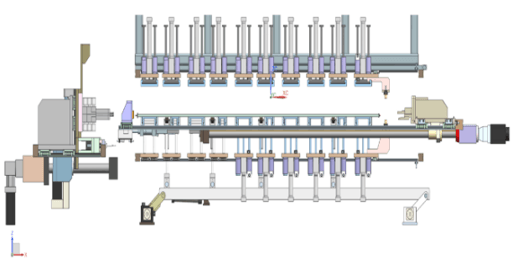
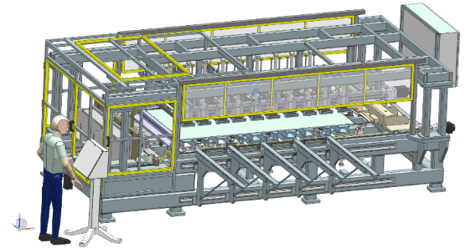
MN Engineering Solutions partnered with the customer to develop a comprehensive Digital Twin environment that replicated the behaviour and operational characteristics of the physical machine. The objective was to create a realistic simulation environment where machine motion, control logic, sensors, actuators, and operational sequences could be tested before the physical machine was built.
Digital Twin Development & Virtual Commissioning
Existing 3D CAD models and machine kinematics were transformed into an interactive Digital Twin where mechanical constraints, kinematics, electrical signals, sensors, actuators, and PLC logic were integrated into a unified simulation environment. Real-time closed-loop communication was established between the virtual machine and the PLC simulation, enabling the control software to interact with the Digital Twin exactly as it would with the physical hardware.
Before validating machine sequences, comprehensive I/O testing was conducted for servo motors and drives, position sensors, limit switches, pneumatic cylinders, safety devices, and communication interfaces. Once communication and hardware simulation were verified, engineers conducted detailed validation of machine operating sequences including homing sequences, initialization procedures, automatic production cycles, safety interlocks, emergency stop, alarm handling, manual operating modes, and recovery after power failure.
Identifying Issues & Operator Training
Through extensive simulation and testing, the engineering team successfully identified sequence logic inconsistencies, cycle time optimization opportunities, motion synchronization issues, potential component collisions, sensor interaction problems, and software anomalies. Instead of discovering these issues during physical commissioning—where corrections are often costly and time-consuming—they were addressed in the virtual environment.
In addition to engineering validation, the Digital Twin environment provided substantial value for operator training. Using the virtual machine environment, operators were able to understand machine functionality, practice operating procedures, learn sequence logic, familiarize themselves with HMI controls, experience fault handling scenarios safely, and understand machine maintenance and troubleshooting procedures.
Outcome
The implementation of the Digital Twin and Virtual Commissioning solution delivered measurable benefits across the machine development lifecycle.
- Successful virtual commissioning of the complete machine, including sensors, servo systems, and pneumatic devices.
- Early detection and correction of sequence errors and collision risks.
- Improved machine software quality through extensive pre-build testing.
- Reduced machine downtime during installation.
- Enhanced operator readiness through virtual training.
- Shorter machine development and commissioning timelines.
- Reduced engineering rework & machine commissioning risk.
Most importantly, the customer gained a repeatable framework for future machine development programs, enabling faster product introductions and improved engineering efficiency.
Conclusion
By integrating Digital Twin technology with Virtual Commissioning, MN Engineering Solutions enabled the customer to transform its machine development process from reactive physical commissioning to proactive virtual validation. The solution allowed engineers to test, optimize, and validate machine behaviour before manufacturing, reducing commissioning risks, improving software quality, accelerating machine delivery, and establishing a repeatable digital engineering framework for future Special Purpose Machine development.