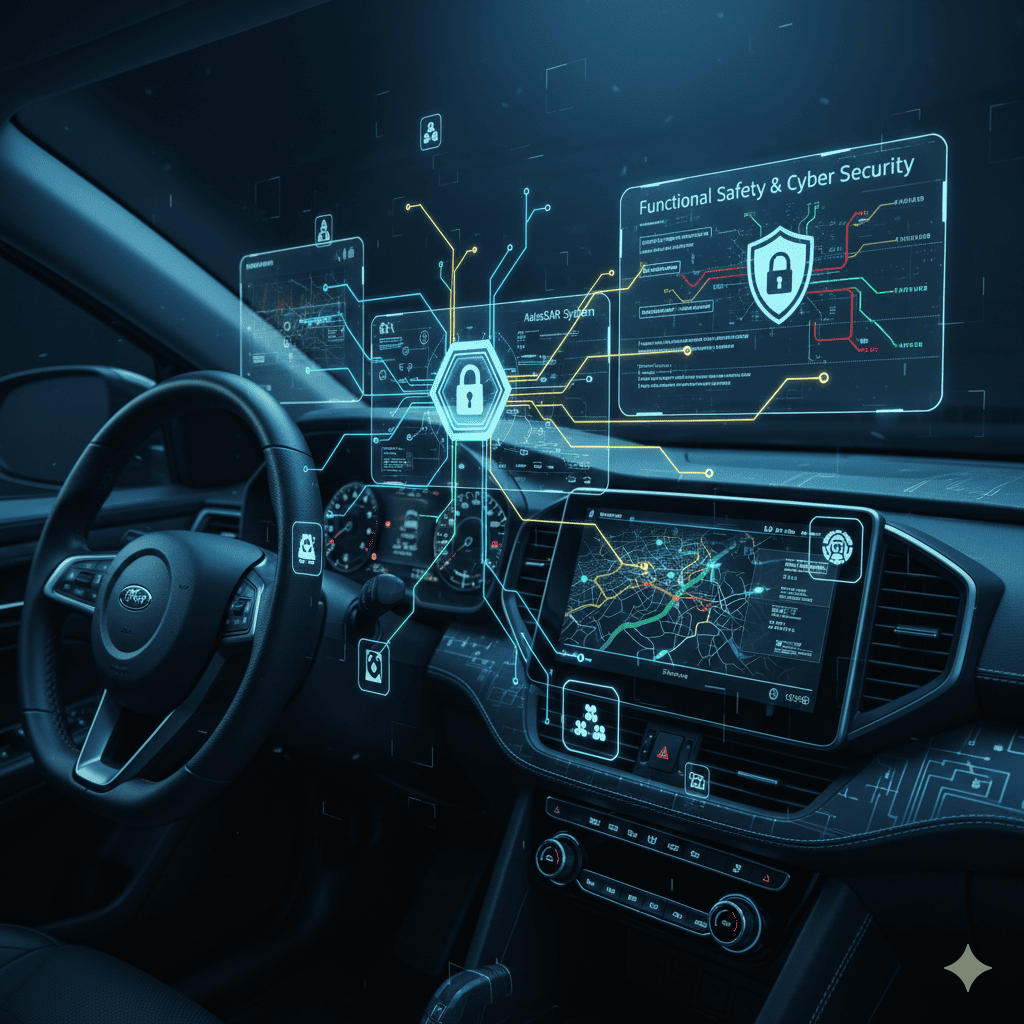
Cybersecurity in road vehicles refers to the safeguarding of automotive electronic systems, communication networks, control algorithms, software, users, and underlying data from malicious attacks, unauthorized access, and manipulation. As modern vehicles become increasingly connected and complex, automotive cybersecurity has become a fundamental requirement rather than a luxury. Ensuring automotive system security is critical to maintaining the safety, privacy, and reliability of today’s vehicles.
With the expansion of digital features and connectivity, in-vehicle network security plays a key role in defending against threats that target communication between vehicle components. The rise of smart mobility has also heightened the need for cybersecurity for connected vehicles, addressing risks associated with telematics, infotainment, ADAS, and over-the-air updates.
Implements secure boot, secure flash, diagnostics, CMAC, signature verification, and grey-box penetration testing to safeguard Battery Management Systems (BMS)
Develops secure onboard communication protocols to protect Domain Controllers against unauthorized access
Supports Volkswagen Bootloader requirements to ensure cybersecurity compliance in HVAC systems
Integrates virtual HSM (vHSM), secure flashing, secure boot with CMAC, and secure communication for zonal controller protection
Enables vHSM integration, signature verification, secure flashing, diagnostics, memory management, and trusted communication in inverter systems
The rise of smart mobility has also heightened the need for cybersecurity for connected vehicles, addressing risks associated with telematics, infotainment, ADAS, and over-the-air updates. This growing challenge has led to an increased focus on comprehensive automotive cybersecurity management in the USA, driven by regulatory frameworks and evolving technologies that influence how security is implemented across the automotive lifecycle.
Cybersecurity refers to the practice of protecting systems, networks, and data from digital attacks, unauthorized access, and damage. It covers hardware, software, and user-level security.
Cybersecurity in automotive is crucial to prevent unauthorized access to critical vehicle functions and protect user data. As vehicles become more connected, strong security ensures safety, privacy, and system integrity.
Automation in cybersecurity refers to using technology to perform security tasks—like threat detection, response, and compliance—without manual intervention. It helps organizations react faster to threats, reduce human error, and improve efficiency.
Advantages of cybersecurity include:
Cybersecurity falls under the Information Technology (IT) industry, specifically within the subdomain of IT security or cybersecurity services. It also intersects with industries like telecommunications, defense, automotive, finance, and healthcare, where data protection and system security are critical.
Key threats include remote hacking of ECUs, unauthorized access through connected devices, over-the-air (OTA) update vulnerabilities, manipulation of ADAS functions, and data theft via infotainment or telematics systems.
ISO/SAE 21434 is the global standard for automotive cybersecurity. It provides a framework for managing cybersecurity risks throughout the lifecycle of electrical and electronic (E/E) systems in road vehicles—from design and development to decommissioning.
Cybersecurity ensures that automotive embedded systems, which control everything from braking to infotainment, are protected from tampering, unauthorized access, and functional disruption—safeguarding both driver safety and vehicle performance.
Penetration testing simulates cyberattacks to identify vulnerabilities in vehicle software, ECUs, and communication systems. It is a critical part of validating the resilience of automotive systems against real-world threats.
Best practices include:
The images of projects displayed on this website are not owned by our company and may be subject to third-party copyrights. We disclaim any liability for copyright infringement related to these images. The data provided on this site is for informational purposes only, based on our internal estimates. This information is not intended to serve as an indication of Key Performance Indicators (KPIs) and is provided "as is" without any warranties, either express or implied, regarding its accuracy, completeness, or reliability.